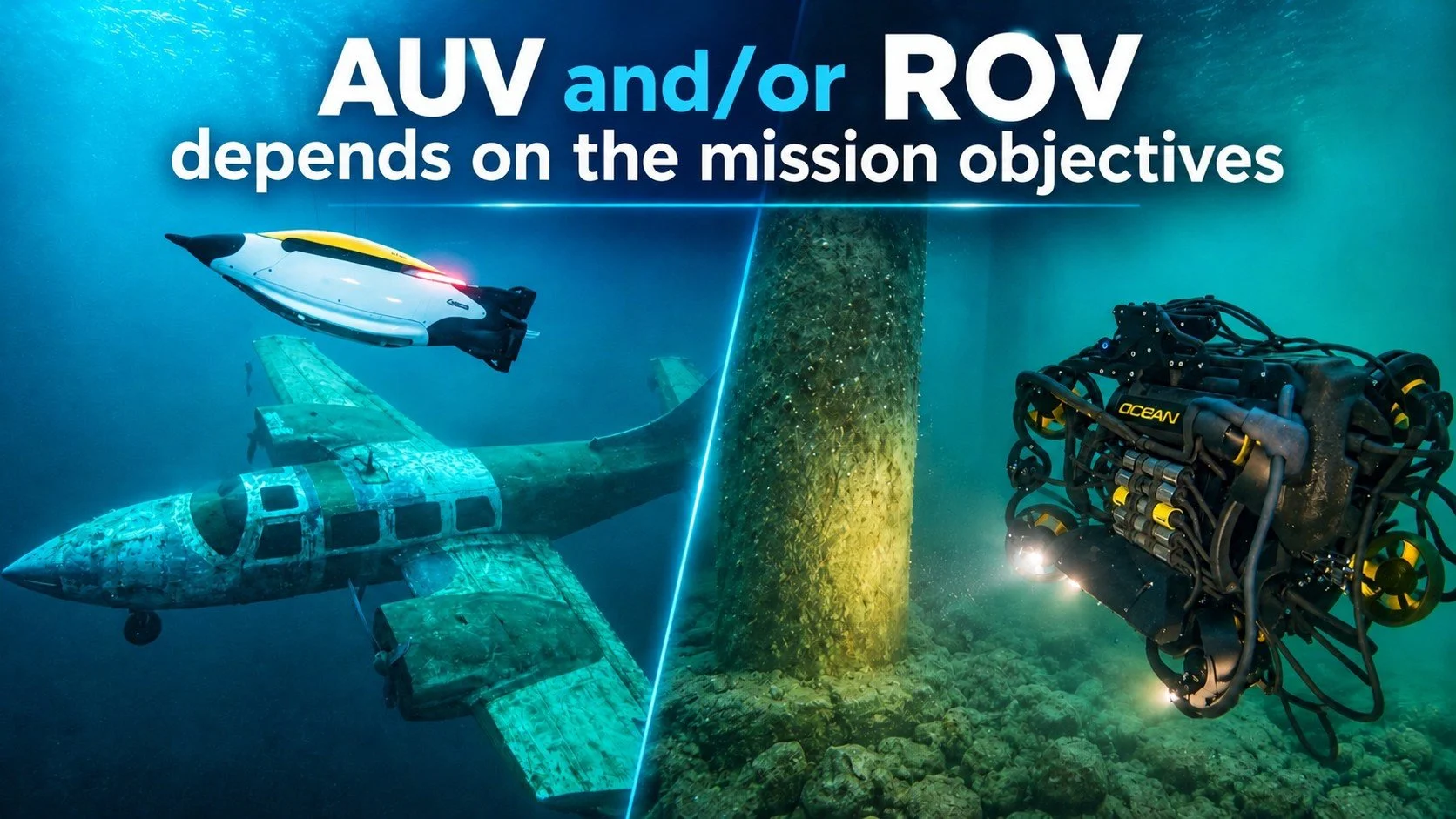
Both AUVs (Autonomous Underwater Vehicles) and ROVs (Remotely Operated Vehicles) are widely used for underwater inspection, surveying, mapping, and research. The key difference lies in how they are operated and the mission objectives.
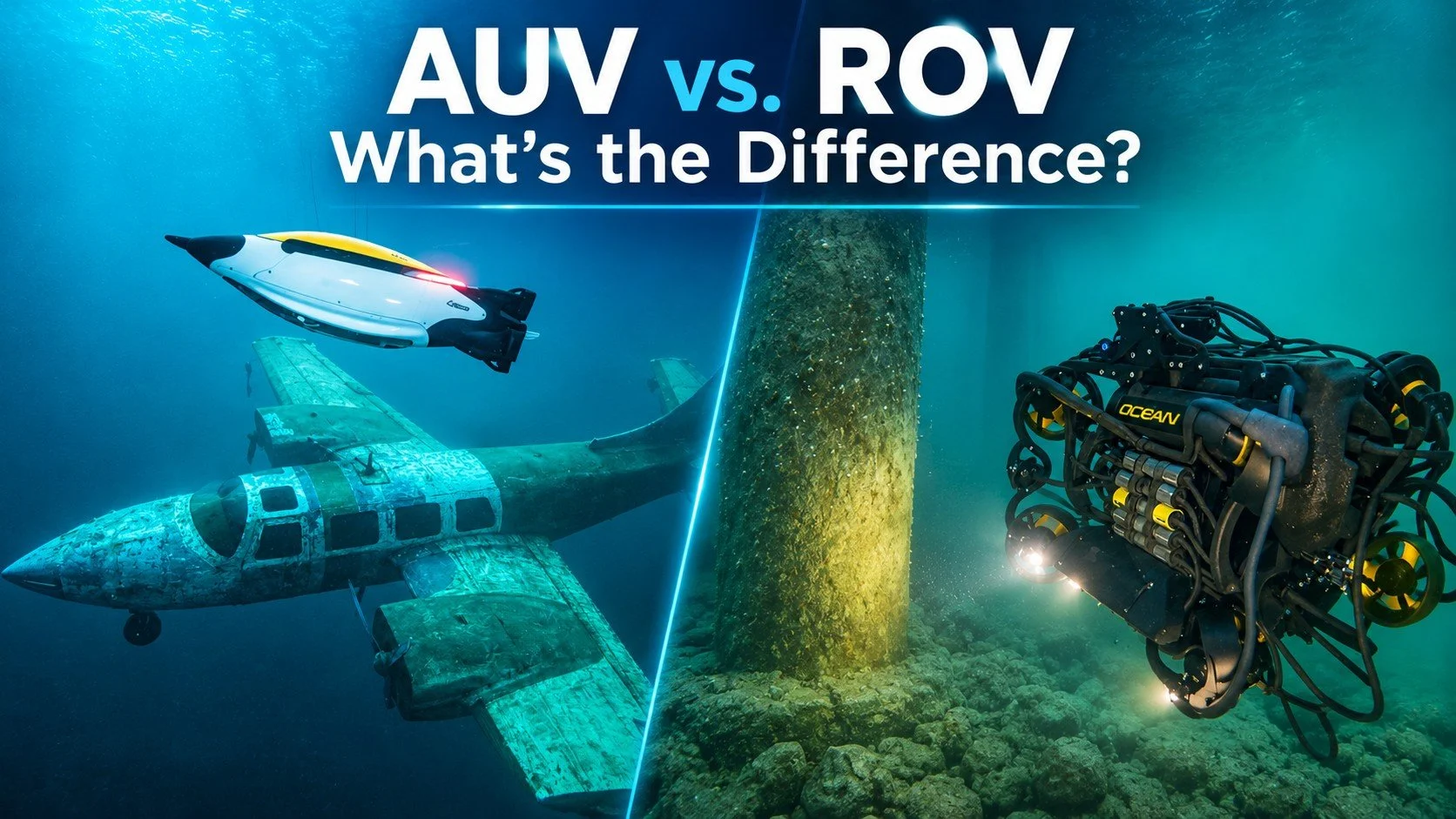
ROVs (Remotely Operated Vehicles)
ROVs are tethered to a surface control box and controlled in real time by an operator (autonomous operation is possible). The ROV provide live video feeds and allow precise maneuvering, making them ideal for inspections, intervention tasks, infrastructure surveys, and situations where immediate human control is required.
Key Advantages
ROV
Real-time control and monitoring.
Tether enables
Real-time data transfer
Live video and sensor feedback
Autonomous operation is possible
Ideal for inspections and intervention tasks
Suitable for confined or complex environments
AUVs (Autonomous Underwater Vehicles)
AUVs, on the other hand, operate autonomously without a tether. They are programmed with a mission plan and can cover large areas efficiently while collecting high-quality survey data. AUVs are commonly used for seabed mapping, hydrographic surveys, environmental monitoring, defense applications, and offshore exploration. AUVs can carry out complex cooperative multi-vehicle network operational tasks with minimal human intervention.
Key Advantages
AUV
Fully autonomous operation
Reduced operational costs for extensive mapping missions
High-quality data collection with minimal human intervention
AI-powered onboard processing Runs directly on the vehicle, analyzing side-scan sonar and video camera feeds to detect various object classes in real time during the mission. Through the acoustic link, detection type and location are transmitted to the control station for immediate evaluation
Efficient coverage of large survey areas
Which System Is Right for Your Mission?
The choice between an AUV and an ROV depends on the mission objectives. If direct control and real-time observation are essential, an ROV is often the best solution. If the goal is to efficiently survey large underwater areas and gather extensive datasets, an AUV is typically the preferred platform.
At the end of the day, it's all about having the right tools in the toolbox. Whether you need to drill a hole or drive a nail, the key is to use the tool that does the job most effectively.